
Lithium-ion batteries store and release energy by moving lithium ions between a cathode and an anode. Their high energy density, efficiency, and long cycle life made them central to portable electronics, electric vehicles, and modern energy storage.
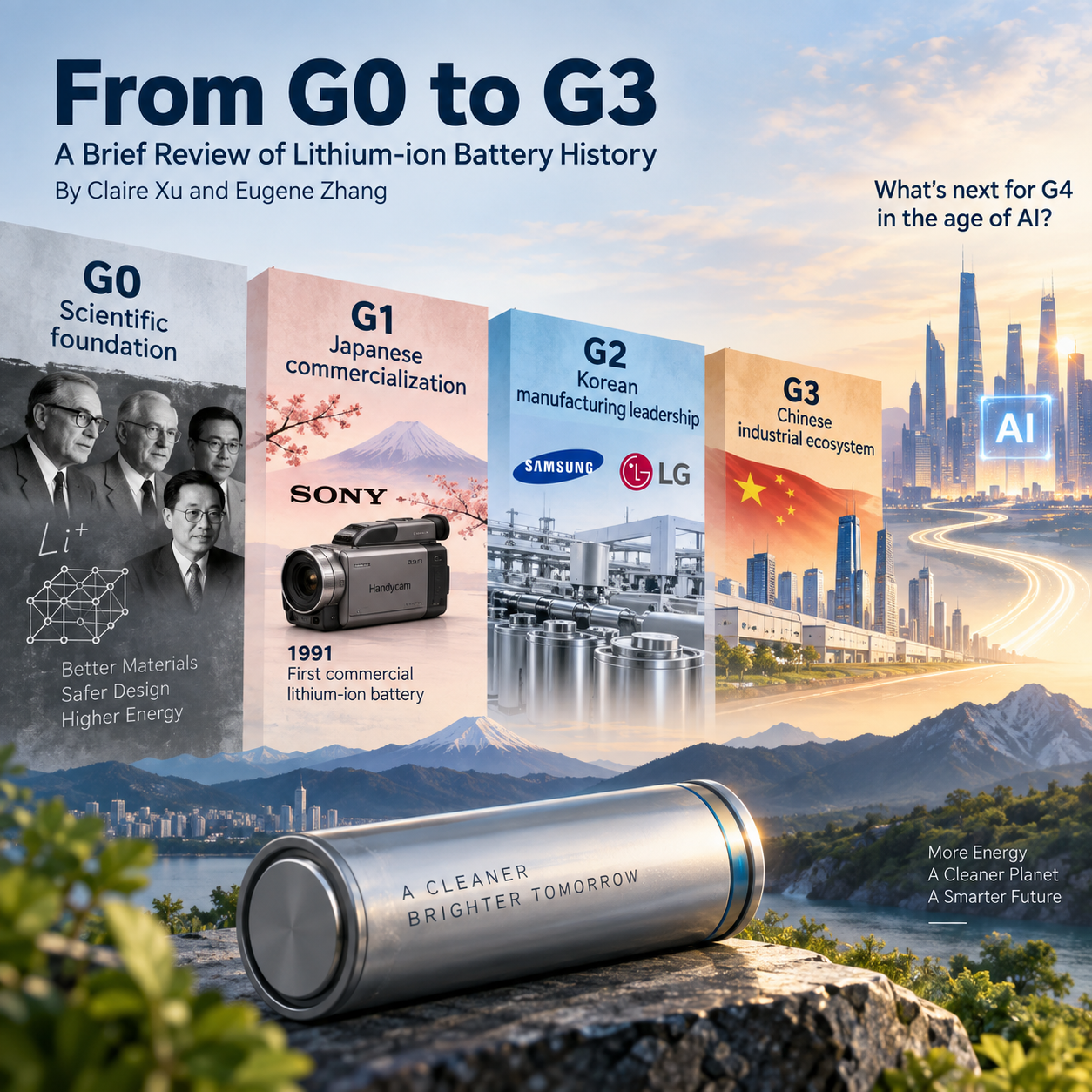
The industry was not built through one breakthrough or by one country. It developed through a series of handoffs: scientists created the foundation, Japan commercialized it, Korea learned to manufacture it at scale, and China built an industrial ecosystem around it. What’s the most interesting is the future, where do we go from here for G4 in the age of AI.
G0 — Scientific foundation
The story began with a basic problem: lithium could store enormous amounts of energy, but it was difficult to use safely.
In the 1970s, M. Stanley Whittingham was working at Exxon’s research laboratory in New Jersey when he developed an early rechargeable lithium battery using a titanium disulfide cathode and a lithium-aluminum anode. The battery proved lithium’s potential, but metallic lithium could form structures during charging that caused internal short circuits and fires. The chemistry worked, but it was not yet ready for the market.
John Goodenough solved another part of the puzzle. In 1980, his research showed that lithium cobalt oxide could serve as a higher-voltage cathode, allowing the battery to store and deliver more energy. Around the same period, Rachid Yazami’s work demonstrated that lithium could be reversibly inserted into graphite, helping establish the material that would later become the dominant commercial anode.
The final breakthrough came from Akira Yoshino at Asahi Kasei in Japan. Instead of using lithium metal as the anode, Yoshino used a carbon-based material that could store lithium ions with fewer safety risks. By combining this anode with Goodenough’s cathode, he created the basic architecture of the modern lithium-ion battery.
The G0 lesson is that the battery was not created by one inventor. Whittingham made the concept work, Goodenough increased its voltage, Yazami helped establish graphite’s role, andYoshino made the design safer and more practical.
G1 — Japanese commercialization
Japan turned the scientific breakthrough into something consumers could hold in their hands.
Yoshino was working at Asahi Kasei, a chemical company—not a consumer-electronicsmanufacturer—when his team developed the carbon-anode solution. Sony saw how the technology could solve a growing problem: portable electronics were becoming more powerful, but their batteries remained heavy, bulky, and limited.
Sony worked with Asahi Kasei to turn Yoshino’s design into a commercial cell. In 1991, Sony introduced the first commercial rechargeable lithium-ion battery, initially for products such as its Handycam camcorders. The value was immediately visible: a lighter device that could run longer.
The difficult part was not simply choosing the right chemistry. Sony had to make the cell safe, reliable, and consistent enough to produce at scale. Asahi Kasei contributed materials expertise, while Sony contributed product design, manufacturing, and access to consumers. Toshiba and Asahi Kasei followed with their own commercial venture in 1992, helping expandJapan’s early battery ecosystem.
G1 was the moment lithium-ion batteries stopped being a scientific possibility and became a commercial platform.
G2 — Korean manufacturing leadership
Korea entered the battery market after Japan had already shown that lithium-ion technology worked. The opportunity was to learn how to produce it better, cheaper, and in much larger volumes.
Samsung’s story captures that transition. Samsung SDI’s battery business began in earnest in the late 1990s, after the company had developed deep experience in electronics and displays. By 1998, it had developed a cylindrical lithium-ion battery, and in 2000 it began mass-producing a 2,000 mAh cylindrical cell—larger than the 1,600 mAh models then common in the market.
Korea also went directly to the source of the industry’s knowledge. Samsung established the Samsung R&D Institute Japan in 1997 with a small founding team. Research on Korea’s rapid catch-up with Japan points to Japan-based R&D, cross-border collaboration, and knowledge transfer from Japanese engineers as important parts of the process. The popular version is that Korean companies went to Japan, recruited talent, and learned the playbook. The more precise version is that they combined R&D offices, collaboration, hiring, and manufacturing experience to absorb knowledge that could not be learned from technical papers alone.
LG Chem followed a complementary path, using its experience in chemicals and materials to move into battery cells and eventually electric-vehicle supply. Together with Samsung SDI and SK Innovation, LG helped turn Korea into a serious manufacturing competitor to Japan.
The advantage was not only laboratory research. It was the ability to control defects, tune production processes, handle sensitive materials, calibrate equipment, and deliver consistent cells to demanding automotive customers.
G2 was the shift from commercialization to manufacturing excellence. Japan proved that lithium-ion batteries could be sold. Korea showed that a new entrant could learn from the incumbent and compete through quality, scale, and execution.
G3 — China’s industrial ecosystem
China’s rise began with a familiar strategy: take a proven technology, learn how to make it competitively, and build a much larger market around it.
BYD: From batteries to vehicles
BYD was founded in Shenzhen in 1995 with approximately 20 employees and RMB 4.5 million in capital. Its founder, Wang Chuanfu, was a chemist who understood both the technical challenge and the commercial opportunity in rechargeable batteries. BYD began by making batteries for mobile phones.
Japanese companies dominated the market, so BYD found an opening in lower-costmanufacturing. It studied established designs, improved its production methods, and competed on price and speed.
The company eventually decided that supplying batteries was not enough. In 2003, BYD acquired Qinchuan Automobile and entered the vehicle business. That created a powerful feedback loop: BYD could design the battery, build the vehicle, and learn from both.
The battery became the center of the company’s strategy. Its vehicle business created demand for batteries, while its battery business gave the vehicle company greater control over cost, design, and supply. Its strength in lithium iron phosphate batteries also reflected a distinct set of priorities: lower cost, safety, long life, and scalable mass-market deployment.
CATL: From consumer electronics to electric vehicles
CATL followed a different path.
Its roots go back to Amperex Technology Limited, or ATL, founded by Robin Zeng in 1999 to produce lithium-ion batteries for laptops and other portable devices. ATL built experience in consumer batteries and later became part of Japan’s TDK. In 2011, Zeng and his partners separated ATL’s electric-vehicle battery operation and created Contemporary Amperex Technology, better known as CATL.
The timing was critical. China was beginning to build a large electric-vehicle market, supported by industrial policy, growing consumer demand, and a rapidly expanding manufacturing base.
Unlike BYD, CATL did not need to sell cars to benefit from that market. It became the battery supplier behind multiple automakers, allowing it to focus on cell chemistry, manufacturing scale, and customer integration.
BYD and CATL represent two paths to Chinese battery leadership. BYD integrated batteries with vehicles. CATL specialized in becoming the battery platform for the automotive industry, carrying ATL’s consumer-electronics experience into electric vehicles. Around them, companies such as EVE Energy, Gotion, CALB, and Lishen added depth to China’s competitive battery market.
China’s advantage therefore did not depend on two exceptional companies alone. It came from a broad industrial field linking chemical processing, cathode and anode materials, manufacturing equipment, skilled labor, capital, EV demand, and recycling. By 2020, China represented roughly 75% of global lithium-ion production capacity.
Why the history matters
Lithium-ion history shows that scientific discovery does not automatically produce industrial leadership.
The United States and Europe helped establish much of the scientific foundation. Japan commercialized the technology. Korea learned from the incumbent and built manufacturing excellence. China connected materials, factories, automakers, infrastructure, and demand into a broader system.
At each stage, the bottleneck changed. First, researchers had to make lithium batteries scientifically viable. Japan then had to make them safe and commercially useful. Korea had to manufacture them with high quality and low defects. China expanded the challenge by coordinating the supply chain and creating enormous downstream demand.
The chemistry continues to evolve. Lithium cobalt oxide remains common in consumer electronics; NMC and NCA prioritize energy density for many electric vehicles; and LFP offer slower cost, long life, and reduced dependence on nickel and cobalt. Safety, degradation, mineral supply, and recycling remain central constraints.
Core takeaway
Lithium-ion batteries did not become a global industry through one invention or one country. They advanced through a series of handoffs: scientific discovery created the possibility, Japan commercialized it, Korea learned to manufacture it at scale, and China built an ecosystem around it
The deeper lesson is that technological leadership compounds. Each generation inherits the knowledge, talent, equipment, suppliers, and markets developed by the previous one—and uses them to build the next industrial advantage. The winner is not necessarily the country that makes the first breakthrough, but the one that learns fastest and builds the strongest system around it.
Let’s explore how to build the next-generation in the age of AI.

.png)

