
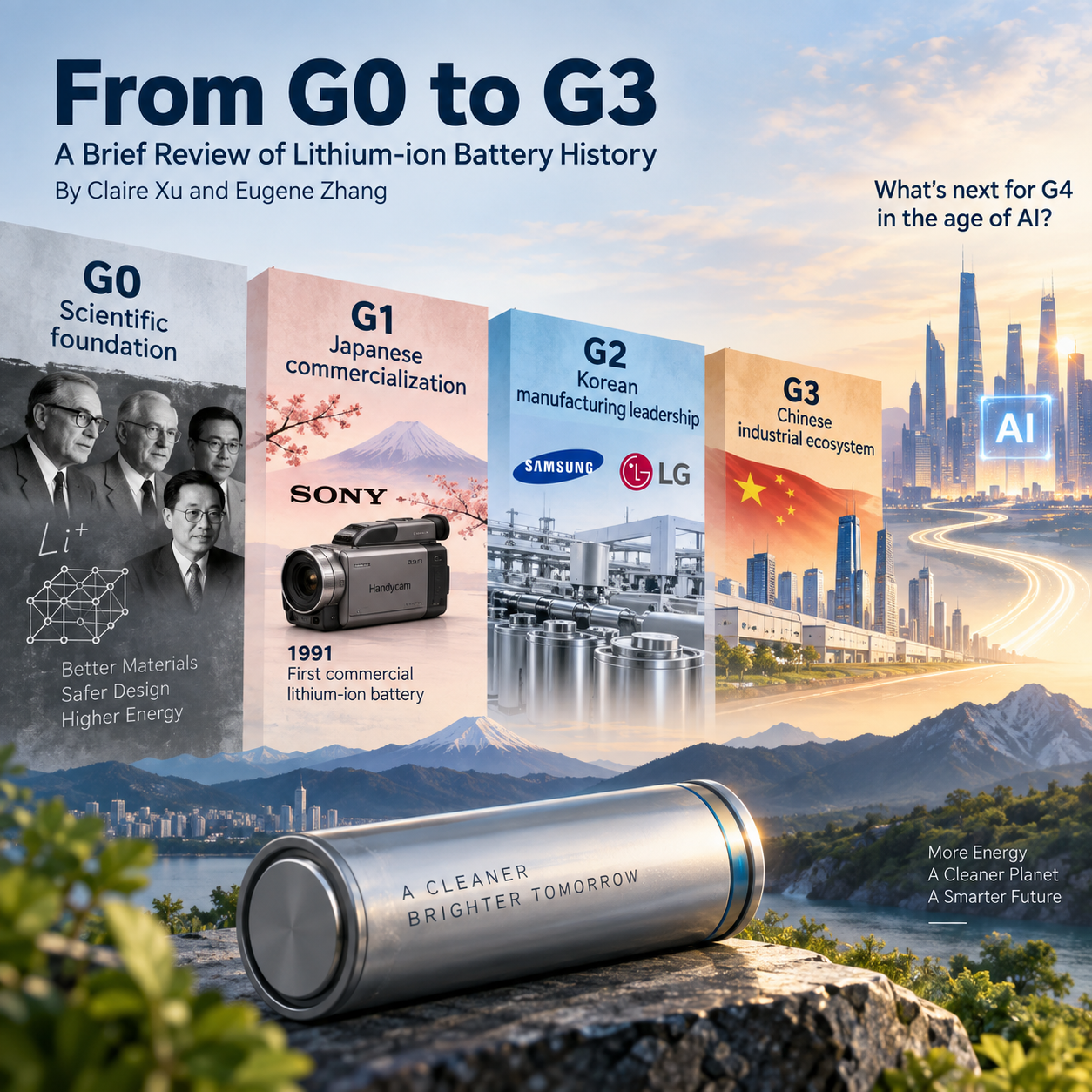
Lithium-ion batteries store and release energy by moving lithium ions between a cathode and an anode. Their high energy density, efficiency, and long cycle life made them central to portable electronics, electric vehicles, and modern energy storage.The industry was not built through one breakthrough or by one country. It developed through a series of handoffs: scientists created the foundation, Japan commercialized it, Korea learned to manufacture it at scale, and China built an industrial ecosystem around it. What’s the most interesting is the future, where do we go from here for G4 in the age of AI.
Lithium-ion batteries store and release energy by moving lithium ions between a cathode and an anode. Their high energy density, efficiency, and long cycle life made them central to portable electronics, electric vehicles, and modern energy storage.The industry was not built through one breakthrough or by one country. It developed through a series of handoffs: scientists created the foundation, Japan commercialized it, Korea learned to manufacture it at scale, and China built an industrial ecosystem around it. What’s the most interesting is the future, where do we go from here for G4 in the age of AI.

Automat Solutions, Inc. has launched an integrated AI workspace for battery electrolyte R&D, bringing formulation search and scientific Q&A into one platform.
Automat Solutions, Inc. has launched an integrated AI workspace for battery electrolyte R&D, bringing formulation search and scientific Q&A into one platform.

Most AI investment discussions start with what foundation models can do. I want to start from the opposite question: what can’t they do, what shouldn’t they do, and what will humans need even more precisely because AI is becoming so powerful?
Most AI investment discussions start with what foundation models can do. I want to start from the opposite question: what can’t they do, what shouldn’t they do, and what will humans need even more precisely because AI is becoming so powerful?

Most AI models generate. Agents need to retrieve and reason on real-world data. With Exa now integrated into Gemini, developers can access a search engine built for agentic use cases, optimized for high-quality results across code, companies, people, and research. Combined with Gemini’s reasoning capabilities, this enables more grounded and reliable outputs. Proud to back the team behind it.
Most AI models generate. Agents need to retrieve and reason on real-world data. With Exa now integrated into Gemini, developers can access a search engine built for agentic use cases, optimized for high-quality results across code, companies, people, and research. Combined with Gemini’s reasoning capabilities, this enables more grounded and reliable outputs. Proud to back the team behind it.

𝗪𝗵𝗲𝗿𝗲 𝘆𝗼𝘂 𝗽𝗹𝗮𝗰𝗲 𝘁𝗵𝗲 𝗽𝗿𝗼𝗱𝘂𝗰𝘁 𝗺𝗮𝘁𝘁𝗲𝗿𝘀 𝗺𝗼𝗿𝗲 𝘁𝗵𝗮𝗻 𝘁𝗵𝗲 𝗽𝗿𝗼𝗱𝘂𝗰𝘁 𝗶𝘁𝘀𝗲𝗹𝗳.One of the most overlooked levers in travel isn’t the product. It’s when you present it.Sherpa°’s work with TUI Netherlands shows this in practice. Instead of treating visa services as a bolt-on, they integrated them into key moments in the journey, when customers are already preparing their trip. The impact:→ 2x eVisa sales→ +114% conversionA clear example of how timing and placement directly drive results
𝗪𝗵𝗲𝗿𝗲 𝘆𝗼𝘂 𝗽𝗹𝗮𝗰𝗲 𝘁𝗵𝗲 𝗽𝗿𝗼𝗱𝘂𝗰𝘁 𝗺𝗮𝘁𝘁𝗲𝗿𝘀 𝗺𝗼𝗿𝗲 𝘁𝗵𝗮𝗻 𝘁𝗵𝗲 𝗽𝗿𝗼𝗱𝘂𝗰𝘁 𝗶𝘁𝘀𝗲𝗹𝗳.One of the most overlooked levers in travel isn’t the product. It’s when you present it.Sherpa°’s work with TUI Netherlands shows this in practice. Instead of treating visa services as a bolt-on, they integrated them into key moments in the journey, when customers are already preparing their trip. The impact:→ 2x eVisa sales→ +114% conversionA clear example of how timing and placement directly drive results
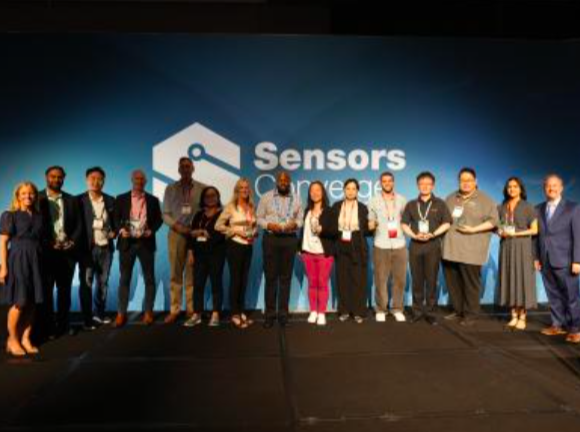
Aizip has been named a finalist for Startup of the Year at Sensors Converge 2026. Selected as one of a handful of companies across the global sensing and electronics ecosystem. 𝗞𝗲𝘆 𝘁𝗮𝗸𝗲𝗮𝘄𝗮𝘆: 𝗧𝗵𝗲 𝗲𝗱𝗴𝗲 𝗶𝘀 𝘄𝗵𝗲𝗿𝗲 𝗔𝗜 𝘄𝗶𝗻𝘀.→ Intelligence is moving on-device→ Real-time processing is becoming standard→ Efficient AI is becoming a requirement, not a feature. That’s exactly the shift Aizip is building for. Winners will be announced live at Sensors Converge (May 6th, Santa Clara). See all finalists
Aizip has been named a finalist for Startup of the Year at Sensors Converge 2026. Selected as one of a handful of companies across the global sensing and electronics ecosystem. 𝗞𝗲𝘆 𝘁𝗮𝗸𝗲𝗮𝘄𝗮𝘆: 𝗧𝗵𝗲 𝗲𝗱𝗴𝗲 𝗶𝘀 𝘄𝗵𝗲𝗿𝗲 𝗔𝗜 𝘄𝗶𝗻𝘀.→ Intelligence is moving on-device→ Real-time processing is becoming standard→ Efficient AI is becoming a requirement, not a feature. That’s exactly the shift Aizip is building for. Winners will be announced live at Sensors Converge (May 6th, Santa Clara). See all finalists

Over the past few years, AI has become impossible to ignore. But most of the discussion still happens at a fairly shallow level: which jobs will be replaced, which industries will be disrupted, and who needs to learn the latest tools before they fall behind. Those questions matter, obviously. Humans do enjoy staring at the smoke while ignoring the building’s structural damage.
Over the past few years, AI has become impossible to ignore. But most of the discussion still happens at a fairly shallow level: which jobs will be replaced, which industries will be disrupted, and who needs to learn the latest tools before they fall behind. Those questions matter, obviously. Humans do enjoy staring at the smoke while ignoring the building’s structural damage.

$333M revenue. $2B+ contracts. 68.5M rides. Zūm is rebuilding one of the largest and most outdated mobility systems. 2025 highlights: • $333M revenue (+35% YoY) • EBITDA breakeven, improving unit economics • $2B+ contracted revenue (long-term, recurring)• 4,000+ schools across 15 states • 68.5M rides (+120% YoY) Powered by AI-driven routing and real-time data, Zūm is turning a $50B legacy system into scalable infrastructure. And the impact: • Kansas City → absences cut from 25% to 5.6% • San Francisco → costs reduced by up to 10% • Oakland → long commutes reduced from 70% to <10% Congrats to Ritu Narayan and the Zum team!
$333M revenue. $2B+ contracts. 68.5M rides. Zūm is rebuilding one of the largest and most outdated mobility systems. 2025 highlights: • $333M revenue (+35% YoY) • EBITDA breakeven, improving unit economics • $2B+ contracted revenue (long-term, recurring)• 4,000+ schools across 15 states • 68.5M rides (+120% YoY) Powered by AI-driven routing and real-time data, Zūm is turning a $50B legacy system into scalable infrastructure. And the impact: • Kansas City → absences cut from 25% to 5.6% • San Francisco → costs reduced by up to 10% • Oakland → long commutes reduced from 70% to <10% Congrats to Ritu Narayan and the Zum team!
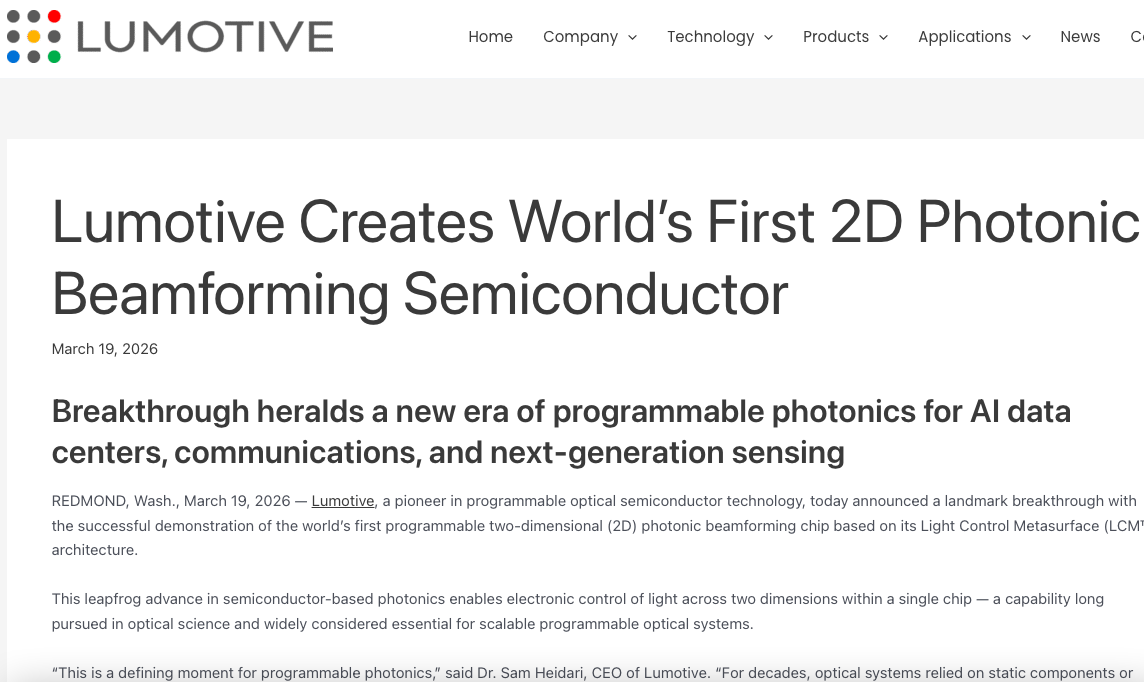
Light just became programmable. Lumotive just demonstrated the world’s first programmable 2D photonic beamforming chip. Why it matters: In RF, beamforming reshaped wireless and radar. This is that moment for photonics. What‘s changed:- Software-defined control of light- No moving parts- Real-time beam steering→ Optics becomes programmable infrastructureWhere this hits:• AI data centers• Optical communications• Robotics & sensingBottom line: This isn’t incremental.It’s a step toward turning light into a compute layer.
Light just became programmable. Lumotive just demonstrated the world’s first programmable 2D photonic beamforming chip. Why it matters: In RF, beamforming reshaped wireless and radar. This is that moment for photonics. What‘s changed:- Software-defined control of light- No moving parts- Real-time beam steering→ Optics becomes programmable infrastructureWhere this hits:• AI data centers• Optical communications• Robotics & sensingBottom line: This isn’t incremental.It’s a step toward turning light into a compute layer.

For DTC businesses, nothing beats TRUST. It can make—or break—companies, even consumer giants. One of our portfolio companies, Musely, is challenging the norm. It has been named one of USA TODAY’s Most Trusted Brands 2026. In Beauty & Health, Musely ranked #7 with a 5-star rating (#57 among the top 500 brands overall), alongside iconic names like Colgate, Neutrogena, Bath & Body Works, and Oakley—and ahead of consumer giants such as Ulta, Sephora, CVS, and household brands like Advil, Clinique, and Oral-B. So why do consumers trust a 6-year-old telehealth brand the same way they trust products that have been around for decades—or even centuries?
For DTC businesses, nothing beats TRUST. It can make—or break—companies, even consumer giants. One of our portfolio companies, Musely, is challenging the norm. It has been named one of USA TODAY’s Most Trusted Brands 2026. In Beauty & Health, Musely ranked #7 with a 5-star rating (#57 among the top 500 brands overall), alongside iconic names like Colgate, Neutrogena, Bath & Body Works, and Oakley—and ahead of consumer giants such as Ulta, Sephora, CVS, and household brands like Advil, Clinique, and Oral-B. So why do consumers trust a 6-year-old telehealth brand the same way they trust products that have been around for decades—or even centuries?
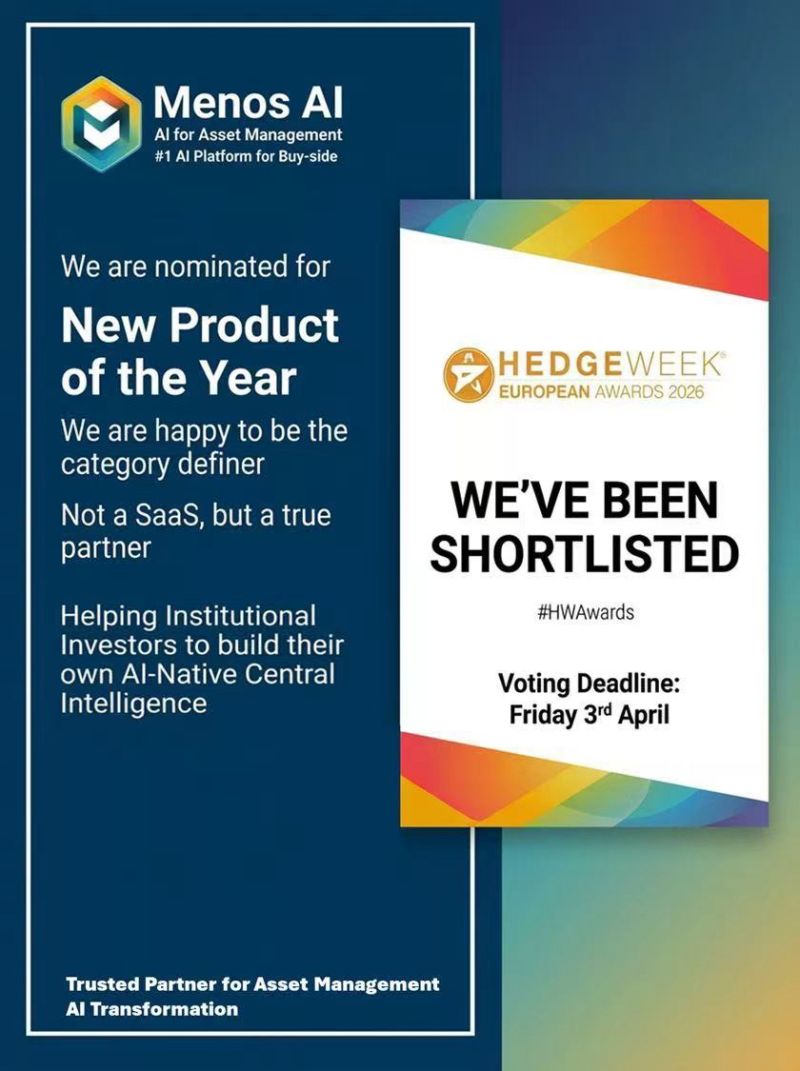
Menos AI has been shortlisted for “New Product of the Year” at the Hedgeweek® EU Awards 2026. AI in asset management is still in its early stages. Most firms are experimenting. Few have operationalized it. That’s exactly where Menos AI comes in. Just as Palantir helps institutions operationalize data, Menos AI helps institutional investors operationalize AI, through a secure, governed, white-label Agent OS built specifically for the buyside. The mission is simple: Help investment organizations build their own AI-native central intelligence.
Menos AI has been shortlisted for “New Product of the Year” at the Hedgeweek® EU Awards 2026. AI in asset management is still in its early stages. Most firms are experimenting. Few have operationalized it. That’s exactly where Menos AI comes in. Just as Palantir helps institutions operationalize data, Menos AI helps institutional investors operationalize AI, through a secure, governed, white-label Agent OS built specifically for the buyside. The mission is simple: Help investment organizations build their own AI-native central intelligence.

Our portfolio company Petal Surgical has announced additional investment following its oversubscribed Series A in 2025, bringing the company’s total funding to more than $25 million. The financing was led by a prominent high-net-worth investment firm, with repeat participation from Draper Associates, Actions Capital (fka K50 Ventures), and Fong’s Family Foundation (Vince Fong). Alongside the investment, surgical robotics pioneer Frederic Moll has joined Petal Surgical’s Board of Directors. The announcement comes just ahead of LSI USA 2026, where Petal will take the stage to share more about its vision for the future of surgery. Congratulations to Prash C. and the entire Petal Surgical team on this milestone.
Our portfolio company Petal Surgical has announced additional investment following its oversubscribed Series A in 2025, bringing the company’s total funding to more than $25 million. The financing was led by a prominent high-net-worth investment firm, with repeat participation from Draper Associates, Actions Capital (fka K50 Ventures), and Fong’s Family Foundation (Vince Fong). Alongside the investment, surgical robotics pioneer Frederic Moll has joined Petal Surgical’s Board of Directors. The announcement comes just ahead of LSI USA 2026, where Petal will take the stage to share more about its vision for the future of surgery. Congratulations to Prash C. and the entire Petal Surgical team on this milestone.

EGI Battery Inc., a U.S.-based advanced battery technology and manufacturing company, today announced the successful close of a $10 million seed financing round led by TSV Capital and supported by several prominent U.S. family offices. The new capital will accelerate the company's manufacturing scale-up, commercial expansion, and continued development of high-performance batteries for aerospace, uncrewed aerial systems (UAS), robotics, and critical infrastructure applications.
EGI Battery Inc., a U.S.-based advanced battery technology and manufacturing company, today announced the successful close of a $10 million seed financing round led by TSV Capital and supported by several prominent U.S. family offices. The new capital will accelerate the company's manufacturing scale-up, commercial expansion, and continued development of high-performance batteries for aerospace, uncrewed aerial systems (UAS), robotics, and critical infrastructure applications.
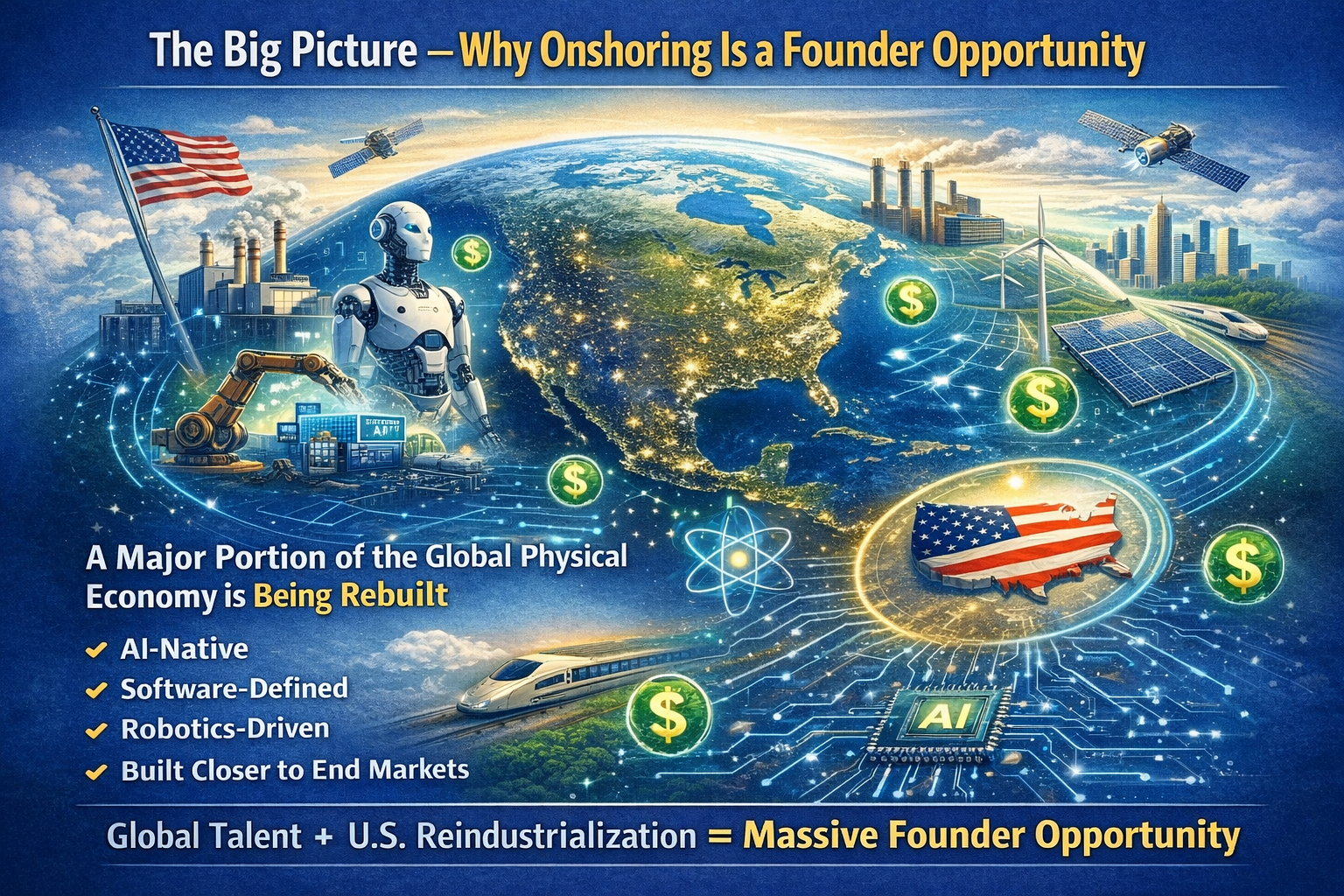
Across this series, we’ve talked about IP, cap tables, capital, factories, and exits. But the big picture is simple: A major portion of the global physical economy is being rebuilt. And it will not be rebuilt the old way.
Across this series, we’ve talked about IP, cap tables, capital, factories, and exits. But the big picture is simple: A major portion of the global physical economy is being rebuilt. And it will not be rebuilt the old way.

Where do all these structural choices show up? At exit. In earlier cycles, buyers focused mainly on growth, margins, and market share. Today, in deep-tech and infrastructure sectors, structural clarity is becoming just as important.
Where do all these structural choices show up? At exit. In earlier cycles, buyers focused mainly on growth, margins, and market share. Today, in deep-tech and infrastructure sectors, structural clarity is becoming just as important.
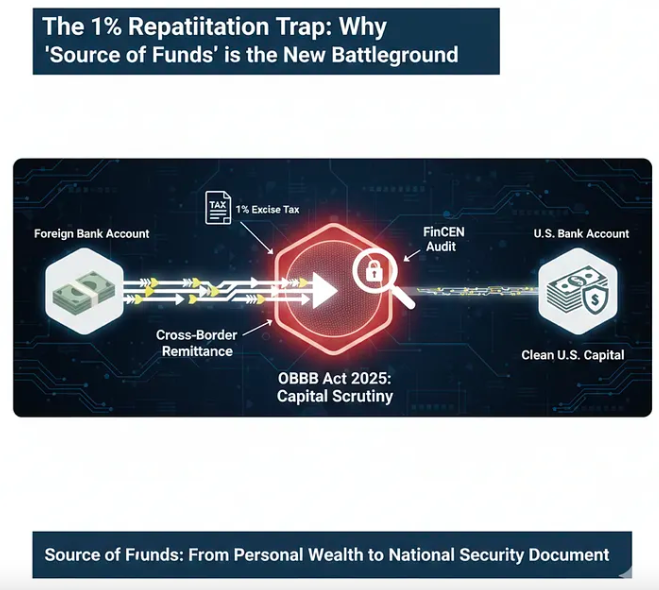
We’ve talked about IP and cap tables. But for many immigrant and repatriate founders, the most personal challenge is capital. In the past, founders could move savings or exit proceeds back to the U.S. with relatively little friction. Today, cross-border capital flows are facing more scrutiny.
We’ve talked about IP and cap tables. But for many immigrant and repatriate founders, the most personal challenge is capital. In the past, founders could move savings or exit proceeds back to the U.S. with relatively little friction. Today, cross-border capital flows are facing more scrutiny.

Why the “Black Box” Factory is the Biggest Risk in 2026 — and the Greatest Opportunity. In my 15+ years at TSVC, I’ve seen countless founders fall into the “Deep Globalization” trap. For decades, the playbook was simple: Design in the U.S., but keep the manufacturing in an offshore “black box” where labor is cheap and environmental regulations are lax. We treated the supply chain as a line item on a spreadsheet, optimizing for the lowest unit cost while ignoring the systemic risks we were building into our foundations.
Why the “Black Box” Factory is the Biggest Risk in 2026 — and the Greatest Opportunity. In my 15+ years at TSVC, I’ve seen countless founders fall into the “Deep Globalization” trap. For decades, the playbook was simple: Design in the U.S., but keep the manufacturing in an offshore “black box” where labor is cheap and environmental regulations are lax. We treated the supply chain as a line item on a spreadsheet, optimizing for the lowest unit cost while ignoring the systemic risks we were building into our foundations.

Why 25% is the most dangerous number in Deep Tech today. In my 15+ years at TSVC, I’ve reviewed thousands of cap tables. Historically, the math was simple: Who has the equity? Who has the voting rights? But in 2026, the OBBB Act and new FEOC (Foreign Entity of Concern) rules have turned the cap table into a national security document. For the next generation of deep-tech founders — particularly repatriates — there is an “Invisible Wall” you must understand: The 24.9% Guardrail.
Why 25% is the most dangerous number in Deep Tech today. In my 15+ years at TSVC, I’ve reviewed thousands of cap tables. Historically, the math was simple: Who has the equity? Who has the voting rights? But in 2026, the OBBB Act and new FEOC (Foreign Entity of Concern) rules have turned the cap table into a national security document. For the next generation of deep-tech founders — particularly repatriates — there is an “Invisible Wall” you must understand: The 24.9% Guardrail.

IP Licensing is the New Liability: Why Your “Clean Room” Needs a Full Buyout. In yesterday’s post, I talked about how the “Passport Test” is dead, replaced by a deep “Sovereignty Audit.” For many founders — especially repatriates — the biggest blind spot isn’t their passport; it’s the very foundation of their business: Intellectual Property. For years, it was common practice: you’d build innovative tech overseas, then bring it to the U.S. under a licensing agreement. It was efficient, it saved upfront costs, and it seemed like a smart way to scale globally. In 2026, this model is a ticking time bomb.
IP Licensing is the New Liability: Why Your “Clean Room” Needs a Full Buyout. In yesterday’s post, I talked about how the “Passport Test” is dead, replaced by a deep “Sovereignty Audit.” For many founders — especially repatriates — the biggest blind spot isn’t their passport; it’s the very foundation of their business: Intellectual Property. For years, it was common practice: you’d build innovative tech overseas, then bring it to the U.S. under a licensing agreement. It was efficient, it saved upfront costs, and it seemed like a smart way to scale globally. In 2026, this model is a ticking time bomb.

15 Years of Backing Immigrant Founders: Why the “Rules of the Game” Just Changed. When we started TSVC ( a.k.a. TEEC Angel Fund) in the heart of Silicon Valley in 2010, the mission was clear: back the most brilliant technical talent in the world, regardless of where they were born. At that time, our entrepreneurs were often immigrants — many from mainland China — who were building deep roots here. Some had US passports, some had Green Cards, and many were navigating the long immigration process.
15 Years of Backing Immigrant Founders: Why the “Rules of the Game” Just Changed. When we started TSVC ( a.k.a. TEEC Angel Fund) in the heart of Silicon Valley in 2010, the mission was clear: back the most brilliant technical talent in the world, regardless of where they were born. At that time, our entrepreneurs were often immigrants — many from mainland China — who were building deep roots here. Some had US passports, some had Green Cards, and many were navigating the long immigration process.


.png)