
Silicon Valley, December 1, 2025 — OpenAGI today officially launched its latest computer-use foundation model, Lux, which achieved a top-tier score of 83.6 on the globally recognized Online-Mind2Web benchmark—significantly outperforming leading models from Google, OpenAI, and Anthropic. With breakthroughs in speed, cost efficiency, and versatility, Lux is now available to developers via API and SDK.
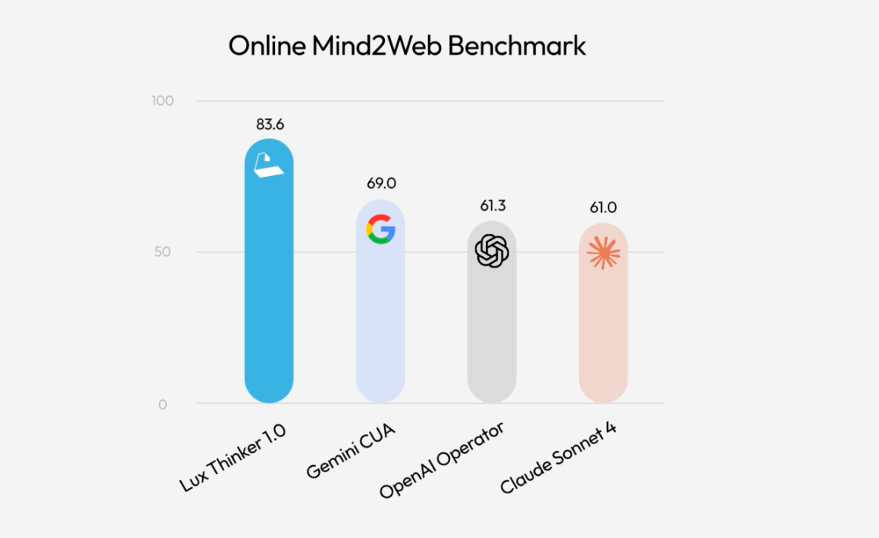
OpenAGI, a research lab committed to building an open ecosystem for computer-use agents, emerged from stealth today with the release of Lux, its most advanced foundation computer-use model to date. On the Online-Mind2Web benchmark, which covers more than 300 real-world web-based computer-use tasks, Lux achieved a score of 83.6, surpassing Google Gemini CUA (69.0), OpenAI Operator (61.3), and Anthropic Claude Sonnet 4 (61.0).
OpenAGI was founded by Dr. Zengyi Qin, who holds a PhD in Computer Science from MIT, a bachelor's degree from Tsinghua University, and is an alumnus of the Stanford UGVR program. Dr. Qin is also a portfolio founder of TSVC Fund V, and OpenAGI marks TSVC’s second investment in a company founded by him, reflecting the firm’s strong confidence in his track record and long-term technical vision.
Lux was developed by a world-class research team from MIT, CMU, and UIUC, and it leads peer models across several critical dimensions:
Developers, researchers, and enterprises can now use the OpenAGI API and SDK to build high-performance, fast, and cost-efficient computer-use applications. Lux-powered agents can support a range of use cases, from automating software QA workflows to conducting deep research through browser use, to creating consumer-facing tools like automated calendar scheduling.
Innovative Training Method: Agentic Active Pre-training
Lux is trained using OpenAGI’s novel Agentic Active Pre-training approach, fundamentally different from the “passive learning” paradigm of traditional LLMs.
While conventional LLMs learn by absorbing internet text—akin to “reading manuals”—Lux learns through active, real-world computer interaction, exploring digital environments and iteratively improving through hands-on experience. This approach also differs from reinforcement learning in its optimization objectives, emphasizing autonomous understanding and exploration, leading to substantially stronger computer-use capabilities.
Building an Open Ecosystem
Unlike closed platforms, OpenAGI is committed to developing an open ecosystem for computer-use agents. Its core training engine, OSGym, is now fully open-sourced. OSGym can run thousands of OS replicas in parallel and generate over a thousand data points per minute, providing researchers with the essential infrastructure required for large-scale agent training.
With the launch of Lux, OpenAGI aims to accelerate progress in the agentic AI field, offer developers a truly deployable computer-use model, and set a new standard for the industry.
Dr. Zengyi Qin, Founder and CEO of OpenAGI, said:
“For 60 years, computers have been tools. Now, with agentic computer-use technology, they are becoming intelligent partners capable of understanding our intentions and handling complexity on our behalf. Lux brings us one step closer to that future. Our commitment is to build an open ecosystem where every developer can participate in shaping the next generation of human-computer interaction.”

.png)

